



Ask any grassroots football club secretary what their most persistent headache is and the answer usually isn't what you'd expect. It's not the pitch booking, or the referee fees, or the FA registration portal. It's lost kit.
Bags left in changing rooms. Training bibs that go home in the wrong holdall. Shin pads that turn up three weeks later in a parent's car. Club-branded jackets that no one can quite remember who was wearing last Tuesday.
It's a small problem on any individual occasion. But it adds up in money, in time and in the quiet frustration of the volunteers who spend their evenings fielding messages about where the goalkeeper gloves have gone.
What Lost Kit Actually Costs
The financial impact on grassroots clubs is more significant than most committees acknowledge until they look at the accounts.
A set of kit for a single junior team typically runs to several hundred pounds. Replacing individual items - a lost training top here, a pair of shorts there - costs between £15 and £40 per piece, depending on the club's supplier. Across a full season, a club with multiple youth teams can easily spend £300–£600 replacing items that weren't lost through negligence but simply through the chaos of matchday logistics.
That's money that could fund a new coaching course, subsidise tournament entry fees, or buy equipment the club actually needs.
Beyond the direct cost, there's the time. Someone has to manage the messages, coordinate the returns, store the found items, and chase the missing ones. For a volunteer committee already stretched across registration, fixtures and fundraising, that's time they don't have.
Why Kit Gets Lost
The pattern is usually the same. Matchdays are busy. Multiple teams use the same facilities. Changing rooms are shared, bags are stacked together, and people leave in a hurry. Kit that belongs to one player ends up in another family's kit bag - sometimes honestly, sometimes through simple confusion.
Away days make it worse. A different venue, less familiarity with the space, longer journeys, and tired kids are a reliable recipe for items being left behind.
The problem with current "solutions" - WhatsApp messages, email chains, posting on the club noticeboard - is that they're reactive. They kick in after something is lost and rely on the right person seeing the right message at the right time. The parent who found a stray shin pad in their kit bag might not see the WhatsApp message for three days, or might not think to post themselves.
What Actually Helps
The most effective interventions share a common characteristic: they create a path from finder to owner that doesn't depend on anyone thinking to check a group chat.
Naming kit directly with iron-on labels, marker pen, whatever works - is the oldest solution and still a decent one for personal items. But it creates a privacy consideration for club kit shared between multiple users, and it doesn't help once a bag is lost rather than just an individual item.
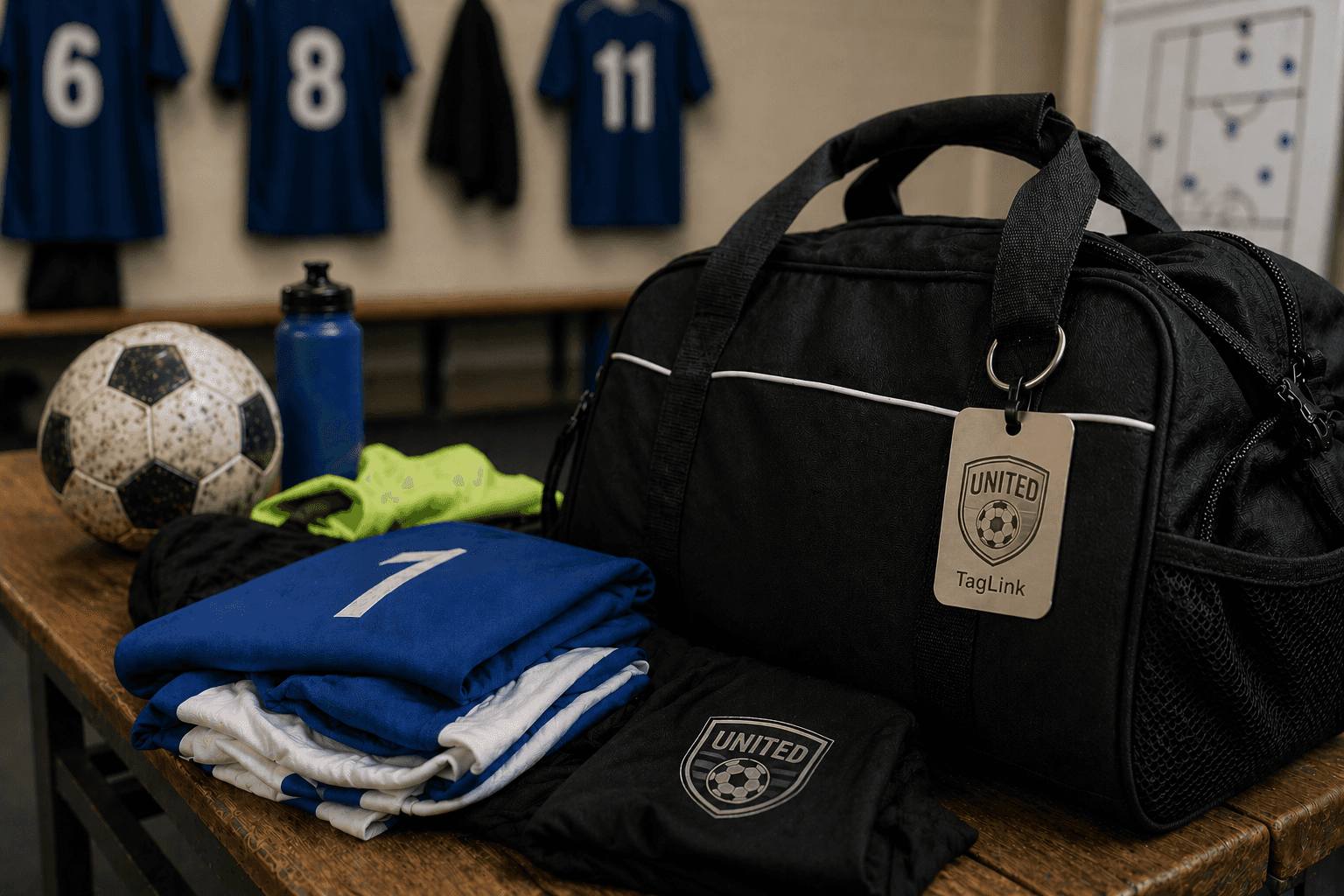
Smart tags change the dynamic. A QR code tag attached to a bag or piece of kit gives anyone who finds it an immediate, frictionless way to contact the owner. No one needs to post in the group chat. No one needs to remember to check the lost property box. The finder scans, sends a message, and the owner is notified.
For club orders, tags can be customised with the club's branding - which has the additional benefit of making it immediately obvious that a piece of kit belongs to your club, even before a scan.
The Volunteer Benefit
This one often gets overlooked in the conversation about lost kit. The people who manage lost property at grassroots clubs are volunteers. Every message they have to field, every item they have to store and track, every awkward conversation about who left what behind - that's time taken away from the things they actually want to be doing.
Anything that reduces that administrative load directly improves the experience of volunteering. And that matters for club sustainability. The clubs that retain good volunteers are the ones that make volunteering feel manageable rather than overwhelming.
How TagLink Works for Clubs
TagLink's club offering is built around a simple process. Packs of custom-engraved tags are ordered with the club crest and, optionally, a sponsor's logo. They're handed out at training. Each player or parent activates their own tag in around 60 seconds - just an email address, no personal details displayed, no app required, nothing for the club to manage.
When a bag is found, anyone can scan the tag and send a one-way message. The owner receives an instant notification. No phone numbers, no addresses, no personal information is ever shown on the tag.
There's no data collection burden for the club, no spreadsheets to maintain, and no chasing. The whole system is designed to work without creating work.
Starting the Conversation at Your Club
The practical case for tagging kit is straightforward enough that it usually doesn't need much selling. Show a committee member a tag, explain how it works in thirty seconds, and the response is almost always: "Why don't we already do this?"
The question is usually about cost and implementation. Both are simpler than expected. Bulk pricing makes club orders significantly more affordable than individual tags, and the rollout - hand them out at the start of the season - is as simple as it gets.
For clubs with sponsors, there's an additional angle worth noting. Branded tags are a visible, daily-use item that keeps a sponsor's logo in front of families throughout the season. That's a sponsorship deliverable most clubs haven't thought to offer - but one that sponsors find genuinely appealing when it's presented clearly. Local businesses that can't stretch to a full kit sponsorship can back a single team pack for £150, with their logo on every tag, at every training session, every matchday, and every tournament.
TagLink works for clubs of all sizes. Custom-branded tags, bulk pricing, simple rollout.
Find out how club packs and sponsor-funded options work at taglink.co.uk/clubs
Founding Club Partner programme now open We're funding a Starter Pack of 10 custom, crest-engraved tags for just 5 grassroots clubs, at no cost and no commitment. First come, first served. Apply at taglink.co.uk/foundingclubs